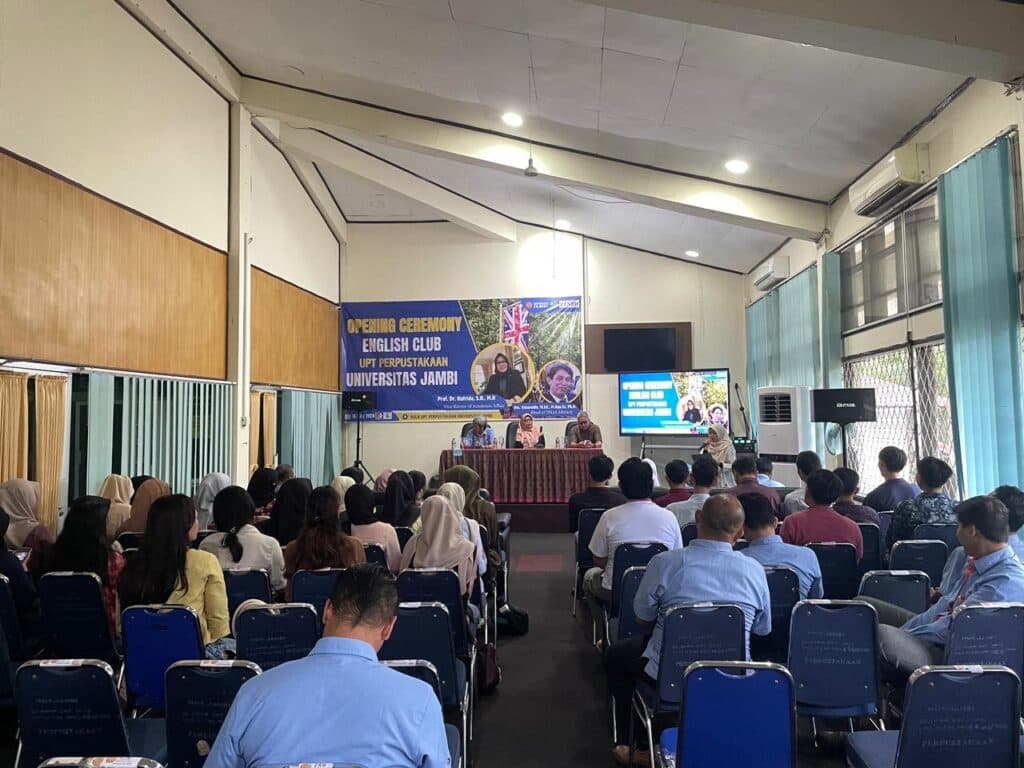
On Thursday, 16 May 2024, the auditorium of Universitas Jambi Library in Mendalo became the setting for a new campus milestone. English Club UPT Perpustakaan Universitas Jambi was formally established and ratified by Prof. Dr. Revis Asra, S.Si., M.Si., then serving as Vice Rector IV for Planning, Cooperation, and Information Systems.
The official account published by Universitas Jambi Library records a ceremony with a clear institutional rhythm. It began with the singing of “Indonesia Raya,” continued with remarks from the Head of the Library Unit and the Vice Rector, and concluded with the club’s formal ratification and a prayer.
English beyond academic grades
Behind that sequence was a practical idea: the university library could hold more than books and study tables. It could also provide room for students to practise a language together.
In his remarks, Prof. Revis Asra praised the library leadership for opening that space. He connected the initiative with Universitas Jambi’s emphasis on innovation and placed English proficiency within a wider view of student readiness. Academic grades remained important, but he argued that English could also matter when graduates entered workplaces where multinational employers considered language ability during recruitment and selection.
The club’s proposed activities reflected that broader purpose. The founding announcement described group discussions, cultural performances, and language seminars as possible ways for students to strengthen their English. Taken together, those formats pointed towards learning through conversation, performance, and shared experience rather than through a single classroom method.
An open door at the library
Inclusivity was part of the plan from the beginning. The club was intended for students across different levels of English proficiency, with the original announcement anticipating varied activities and support from experienced teaching staff. Fluency was not presented as a condition for entering the room.
The report, published five days after the ceremony, documented an intention rather than a set of measured results. It did not claim that every programme had already begun or that the club had already changed students’ outcomes. What it preserved was the moment English Club received an institutional home and a clear direction.
Its founding promise was simple: students did not need to arrive with perfect English. They only needed a place where beginning, practising, and improving could happen together.
Source
Official formation report — Universitas Jambi Library, 21 May 2024